MBA at Columbia University
Table of Contents
- Why Study MBA at Columbia University
- Course Structure of MBA at Columbia University
- Eligibility and Admission Requirements for MBA at Columbia University
- How to Apply for MBA at Columbia University
- Cost of MBA at Columbia University
- Scholarships for MBA at Columbia University
- Student Visa Requirements for MBA at Columbia University
- Career Opportunities After MBA at Columbia University
- Author's POV
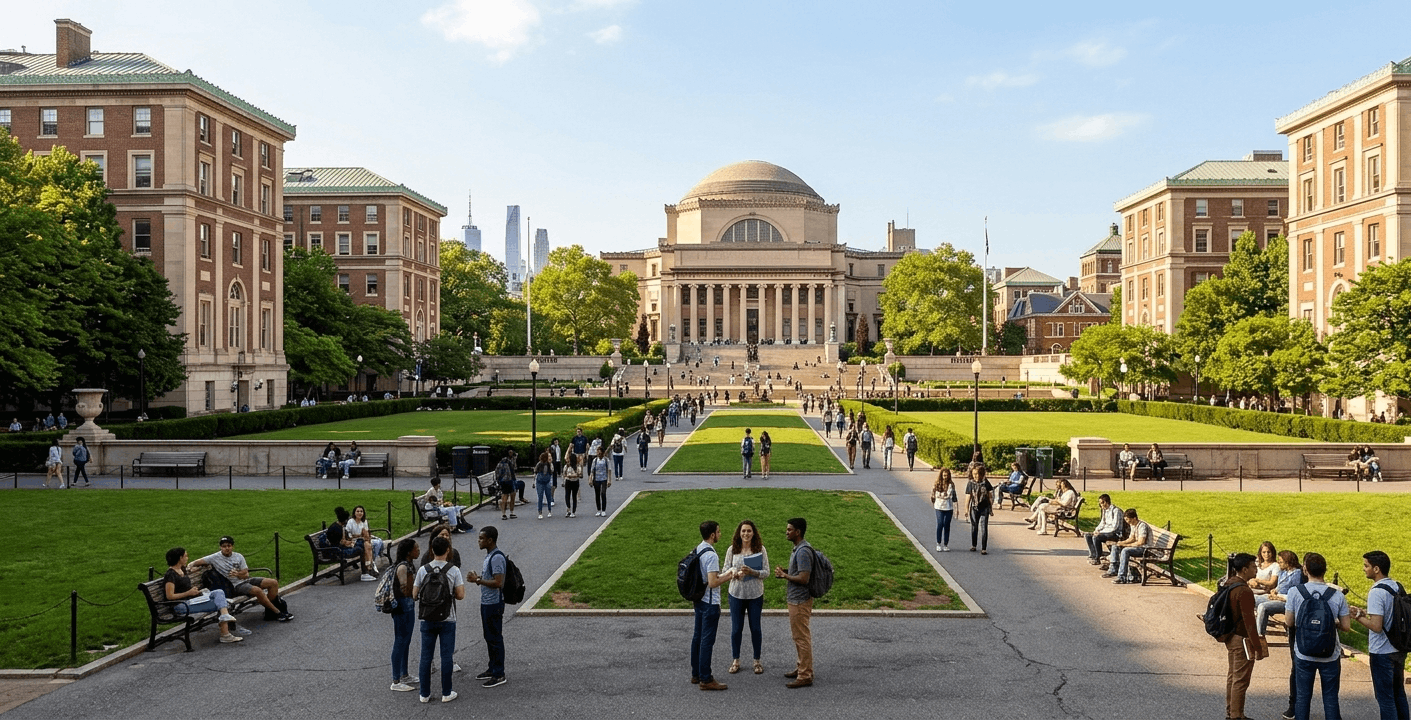
An MBA at Columbia University is one of the most sought-after business degrees in the world, combining Ivy League academic excellence with unmatched access to New York City's global business ecosystem. Offered by Columbia Business School(CBS), the programme prepares future leaders through a rigorous curriculum, experiential learning, and close engagement with industry experts. Students benefit from strong connections to Wall Street, Fortune 500 companies, multinational corporations, and a vast global alumni network.
Whether your goal is investment banking, consulting, entrepreneurship, or technology leadership, an MBA at British Columbia University provides the skills, network, and career opportunities to compete at the highest level of global business.
Key Highlights: MBA at Columbia University
Key Highlights | Course Details |
Programme Duration | 20 months (August intake) or 16 months (January intake, no internship) |
Degree Awarded | Master of Business Administration (MBA) |
University Ranking | #=43 globally, QS World University Rankings 2027 |
Year 1 Tuition (2025-26) | USD 91,172 (INR 87.0 lakh) |
Total Year 1 Cost of Attendance | USD 137,571 (INR 131.2 lakh) |
Two-Year Total Cost | Approx. USD 269,829 (INR 256.9 lakh) |
Class Profile | ~900 students, 65+ nationalities |
Acceptance Rate | Approx. 15-22 percent, depending on round |
Career Outcomes | Consulting, Investment Banking, Private Equity, Technology |
Why Study MBA at Columbia University
Columbia University's QS World University Rankings 2027 position of #=43 tells only part of the story, since Columbia Business School itself is ranked separately, and consistently strongly, on business-specific tables like the Financial Times and QS Global MBA Rankings, where it competes directly with Harvard and Wharton for the top spots globally.
What genuinely sets Columbia apart is its Manhattan location. Business executives visit CBS's campus more frequently than any other top-tier MBA programme in the world, and that proximity to Wall Street, major consulting firms, and global corporate headquarters is baked directly into the curriculum, the case studies, and the entire recruiting calendar, not treated as a side benefit.
A few reasons candidates still choose Columbia despite carrying the highest tuition among the M7:
Direct, walking-distance access to Wall Street, Midtown consulting firms, and the headquarters of dozens of Fortune 500 companies
A genuinely global cohort, with 41 percent international students drawn from 72 countries across the class
A flexible curriculum built around 18 core credits and 42 elective credits, with over 200 electives available across finance, consulting, entrepreneurship, and more
A January entry option running just 16 months, letting candidates skip the summer internship and finish faster if they already have a clear post-MBA direction
One of the fastest MBA payback timelines globally, driven by consistently strong post-graduation salaries across consulting, banking, and technology
CBS's Yellow Ribbon Program, offering supplemental funding for veterans whose GI Bill benefits fall short of covering full tuition
Access to Columbia University's wider Ivy League network, including dual-degree options across law, engineering, and public policy schools on the same campus
Course Structure of MBA at Columbia University
The MBA at Columbia University is built on 60 total credits, split between 18 mandatory core credits covering foundational business disciplines and 42 elective credits, giving students genuine room to specialise across finance, consulting, entrepreneurship, or a mix of several concentrations.
Students are organised into clusters of 65 to 70 people, a structure specifically designed to build close working relationships early in the programme, before the curriculum opens up into its much broader elective phase during the second year.
Course Structure of MBA at Columbia University:
Programme Stage | What It Covers |
Core Curriculum | 18 credits covering finance, accounting, strategy, marketing, and leadership fundamentals |
Electives | 42 credits across 200+ course options, spanning finance, consulting, entrepreneurship, and technology |
Cluster System | Students grouped into cohorts of 65-70 for collaborative learning throughout the core curriculum |
Chazen Global Immersion | Optional study tours, cluster travel, treks, and international business experiences |
Dual-Degree Options | Joint programmes available with Columbia Engineering (MBAxMS), Law, and other schools |
Popular Concentrations Within the MBA at Columbia University
Students typically build their elective schedule around one or two core concentrations, and Columbia's course catalogue is deep enough to support genuinely specialised paths within each.
Concentration | Typical Focus |
Finance | Investment banking, private equity, corporate finance, asset management |
Management Consulting | Strategy consulting, case-based problem solving, client engagement skills |
Entrepreneurship | Venture creation, startup finance, the Lang Center for Entrepreneurship |
Marketing | Brand management, digital marketing, consumer behaviour |
Technology | Product management, tech strategy, growing overlap with Columbia Engineering |
Eligibility and Admission Requirements for MBA at Columbia University
Columbia Business School is genuinely selective, admitting around 15 to 22 percent of applicants depending on the year and application round, with an average GMAT score around 726 to 730 and an average GPA of 3.6 among admitted students.
Unlike many programmes, Columbia doesn't set a fixed minimum years of work experience, but most successful international admits arrive with four to six years, often in consulting, finance, technology, or large corporates, alongside clear, well-articulated career goals.
Academic and Test Score Requirements
Average GMAT score for admitted Full-Time MBA applicants: approximately 726-730
Average undergraduate GPA among admits: approximately 3.6
GRE accepted as a full alternative to GMAT for applicants who prefer it
No fixed minimum years of work experience, though most competitive candidates hold 4-6 years
Work Experience Expectations
While there's no hard cutoff, Columbia's applicant pool skews toward candidates with substantial, well-directed professional experience rather than fresh graduates.
Typical Indian admits carry 4-6 years of experience, often in consulting, finance, tech, or large corporates
Clear career direction and a well-articulated post-MBA goal matter as much as raw years of experience
Candidates with less experience are still considered but face a more competitive bar
English Language Requirements
Columbia Business School does not require TOEFL, IELTS, or Duolingo English Test scores if your prior undergraduate or graduate degree was taught entirely in English at an English-medium institution.
For applicants whose degree wasn't taught in English, proficiency is instead assessed through a combination of methods rather than a single test score:
A strong GMAT Verbal score, typically 160 or above, can demonstrate proficiency
A strong GRE Verbal score, also typically 160 or above, works as an alternative
Interview performance in English is factored directly into the admissions decision
Applicants from English-medium institutions can request a formal waiver by submitting documentation of their institution's language of instruction
How to Apply for MBA at Columbia University
MBA at Columbia University runs a round-based application system across both its August and January intakes, and deadlines close well in advance of the actual start date, so timing your application correctly matters.
Step | What to Do |
Step 1: Choose Your Intake | Decide between the 20-month August track (with internship) or the 16-month January track (without) |
Step 2: Check Eligibility | Review GMAT/GRE expectations, typical work experience, and English proficiency requirements |
Step 3: Prepare Test Scores | Sit the GMAT or GRE; aim for a score in line with the 726-730 average if possible |
Step 4: Compile Application Materials | Gather transcripts, resume, essays, and letters of recommendation |
Step 5: Submit by Your Round Deadline | Apply through Columbia's official admissions portal within your chosen round |
Step 6: Attend an Interview | Selected candidates are invited to interview as part of the evaluation process |
Step 7: Accept Your Offer and Pay Deposit | Confirm your place with the required non-refundable deposit |
Step 8: Apply for Your F-1 Visa | Once your I-20 is issued, begin your visa application process |
Application Deadlines for Upcoming Intakes:
For January 2027 Entry: Round 1 deadline is June 17, 2026
Deposits are non-refundable and vary by admission round:
January intake: USD 2,000 + USD 1,000 (approx. INR 1.71 lakh + INR 85,300)
August Round 1: USD 6,000 + USD 1,000 (approx. INR 5.12 lakh + INR 85,300)
August Round 3: USD 3,000 (approx. INR 2.56 lakh)
Cost of MBA at Columbia University
Columbia Business School publishes an official annual student budget, and it's genuinely the most transparent way to understand the full financial commitment before applying, since it breaks tuition, fees, and living costs into clear, separate line items rather than one bundled estimate.
Official Year 1 Cost of Attendance (2026 Academic Year):
Cost Component | Amount (USD) | Amount (INR, approx.) |
Tuition | USD 91,172 | INR 86.8 lakh |
Mandatory Fees | USD 6,473 | INR 6.2 lakh |
Health Services & Insurance | USD 5,367 | INR 5.1 lakh |
Living Expenses (9-month budget) | USD 34,559 | INR 32.9 lakh |
Total Year 1 Cost of Attendance | USD 137,571 | INR 131.0 lakh |
Note: Tuition and fees generally increase by 2% to 7% in the second year, putting Year 2 tuition at approximately USD 94,800 (approx. INR 80.9 lakh). The estimated total two-year cost, including tuition, mandatory fees, and living expenses, comes to USD 269,829 (approx. INR 2.30 crore).
When you also factor in around two years of forgone salary, the true overall investment typically rises to USD 470,000–520,000 (approx. INR 4.01 crore–4.44 crore).
Cost of Living in New York City for Columbia MBA Students
New York City runs 27 to 131 percent above the US national average depending on the specific comparison used, and it’s remains one of the most expensive cities in the country to live in.
Expense Category | Estimated Monthly Cost (USD) | INR Equivalent |
Cost of living, single person, excluding rent | USD 1,678 | INR 1.60 lakh |
Median 1-Bedroom Apartment Rent (Manhattan) | USD 5,200 | INR 4.95 lakh |
Median Citywide 1-Bedroom Rent | USD 3,500-4,500 | INR 3.33L-4.28L |
Source: Numbeo
Note: Columbia's own official living expense budget of USD 34,559 (approx. INR 29.5 lakh) for a 9-month academic year reflects a more moderate, student-focused lifestyle than Manhattan's general market rents would suggest. Most international MBA students choose off-campus shared housing to manage expenses while building a strong community beyond the classroom.
Scholarships for MBA at Columbia University
Columbia Business School offers merit-based scholarships alongside external funding options, though most awards are partial rather than full-tuition, which matters given Columbia's tuition sits at the highest point among the M7.
Scholarship / Programme | Eligibility | Coverage |
Merit-Based Fellowships | Full-Time MBA admits, evaluated automatically at admission based on academic and leadership profile | Partial tuition reduction, amount varies by candidate |
Yellow Ribbon Program | Veterans whose GI Bill benefits don't cover full tuition | CBS institutional funds matched dollar-for-dollar by the Department of Veterans Affairs |
Veteran Application Fee Waiver | Active-duty military and veterans | Waives the MBA application fee |
External Scholarships | Open to eligible applicants based on background, field, or country of origin | Varies; requires a separate application to external organisations |
Note: Columbia permits MBA students to work up to 20 hours per week on campus, through departments, research centres, and faculty projects, which can meaningfully offset living costs across the two-year programme.
Federal Direct Unsubsidized Loans are also available for US citizens and permanent residents, alongside private loan options for international students, which are worth comparing carefully on interest rates before committing.
Student Visa Requirements for MBA at Columbia University
International students admitted to MBA at Columbia University must apply for an F-1 Student Visa, issued by the US Department of State, the standard route for full-time study at SEVP-approved institutions like Columbia University.
Eligibility Criteria:
A confirmed Form I-20 issued by Columbia after admission and proof of financial resources
Proof of funds covering tuition and estimated living costs, based on the official Year 1 cost of attendance of USD 137,571 (approx. INR 131.2 lakh).
Valid passport with sufficient validity beyond your intended stay
Demonstrated intent to return home after completing your studies
How the F-1 Visa Process Works:
A visa application begins once Columbia issues your Form I-20, confirming your admission and verified financial resources. You'll then pay the SEVIS I-901 fee, complete the DS-160 online form, and schedule a visa interview at your nearest US consulate or embassy.
Financial Requirements:
Cost Item | Amount (USD) | Amount (INR, approx.) |
SEVIS I-901 Fee | USD 350 | INR 33,300 |
DS-160 / MRV Visa Fee | USD 185 | INR 17,600 |
Proof of Funds (Year 1) | USD 137,571 | INR 131.0 lakh |
Documents Required for F-1 Visa:
Valid passport
Form I-20 issued by Columbia University
Proof of financial resources (bank statements, education loan sanction letter, scholarship letter)
Completed DS-160 confirmation page
SEVIS I-901 fee payment receipt
Passport-size photographs meeting US visa specifications
Academic transcripts and GMAT/GRE score reports
Visa appointment confirmation
Work Rules During the Programme
F-1 visa holders can work up to 20 hours per week during the academic term and full-time during official breaks. New York State's minimum wage sits at USD 15 per hour, and common on-campus roles pay meaningfully above that baseline.
On-Campus Role | Approx. Hourly Rate (USD/INR) |
Teaching Assistant / Tutor | USD 18–25/hour (INR 1,535–2,133/hour) |
Research Assistant | USD 17–22/hour (INR 1,450–1,877/hour) |
Campus Ambassador / Student Worker | USD 16–20/hour (INR 1,365–1,706/hour) |
Part-Time Consulting Internship | USD 30–50/hour (INR 2,559–4,265/hour) |
Career Opportunities After MBA at Columbia University
Columbia MBA graduates move into consulting, investment banking, private equity, and technology roles, with the Class of 2026 reporting a median base salary of USD 175,000 (INR 166.7 lakh per year), among the highest of any MBA programme globally, and a placement rate of 89 percent within three months of graduation.
Columbia's Own Reported Outcomes vs. General NYC Market Data:
Role/Industry | Columbia-Reported Median Salary (USD/INR) | NYC Market Range (USD/INR) |
Consulting (Columbia graduates) | USD 190,000 (INR 1.62 crore) | Management Consultant: USD 108,306–150,000+ (INR 92.4 lakh–1.28 crore+) |
Investment Banking (Columbia graduates) | USD 175,000 (INR 1.49 crore) | Financial Analyst: USD 87,074–142,020 (INR 74.3 lakh–1.21 crore) |
Private Equity (Columbia graduates) | USD 175,000 (INR 1.49 crore)75th percentile: USD 203,750 (INR 1.74 crore) | Senior Financial Analyst: USD 118,841–167,089 (INR 1.01 crore–1.43 crore) |
Technology (Columbia graduates) | USD 151,000–170,000 (INR 1.29 crore–1.45 crore) | Business Analyst: USD 87,074–144,532 (INR 74.3 lakh–1.23 crore) |
Source: Glassdoor
Author's POV
An MBA at Columbia University is one of the biggest financial commitments you can make, but it's also one of the few programmes where the potential return can genuinely justify the cost. You're not only paying for an Ivy League degree, you're investing in access to Wall Street, global consulting firms, venture capital, and one of the strongest alumni networks in business. That ecosystem is difficult to replicate elsewhere.
The programme isn't the right fit for everyone, though. If your goal is to break into investment banking, consulting, private equity, or senior leadership roles, Columbia's reputation and recruiter access can be a real advantage. On the other hand, if you're looking for a general management MBA without a clear post-MBA strategy, there are more affordable options that may deliver similar outcomes. The key is choosing the format that matches your career plans. For career changers, the internship-rich August intake usually offers better long-term value, while experienced professionals with a defined path may benefit from the shorter January option.
If you want clarity on your next steps, you can book a free counseling session with our expert. Someone from the team will walk you through your options and answer your questions.